


Marketing-Lehrbuch, Kapitel 2
Business requirements for market-oriented action → Marketing organisation → Organisational structure (section 2.3.1)
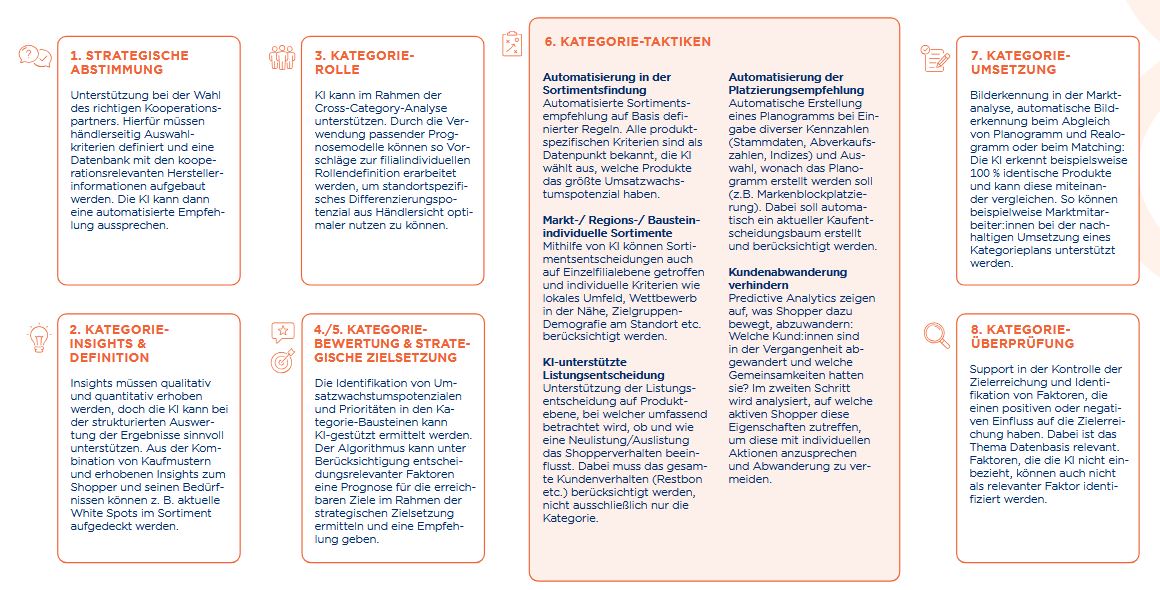
Category management will not be replaced by AI in the future, but this key technology of digitalisation opens up new possibilities: Automated processes will take over time-consuming tasks and free up time for strategic considerations. According to a study by Kantar, manufacturers and retailers are planning to invest more in AI over the next few years in order to better understand customer data, recognise trends at an early stage and plan and implement strategies more quickly. The study shows that AI delivers high added value, particularly in terms of demand planning, competitive analysis and pricing strategy. In addition, relevant market developments can be identified more reliably, product ranges and promotions can be planned better and the customer journey with its numerous touchpoints can be analysed more precisely.
Data forms the necessary basis for every learning system. Based on a wide range of data, AI enables decision-makers to make better decisions and optimally utilise sales potential. In addition to data quantity, data quality also plays a decisive role: AI systems are based on pattern recognition and learning algorithms that are trained to recognise certain patterns in the available data and derive insights from them. If data is incomplete or incorrect, the AI works inaccurately or incorrectly.
Specific examples of the use of AI in category management:
The following figure provides an overview of the possible applications of AI in various areas of category management.

Additional material for the individual chapters:
3-2: Telecoms advertising - importance of mirror neurons for emotional reactions
3-4: Measuring implicit attitudes using the implicit association test (IAT)
3-6: Subjective perception: Are two tables identical or not?
3-7: The eye eats too: Visual perception influences our feeling of hunger
3-8: Febreze: Importance of habitualised decisions for marketing
4-2: Operationalisation and measurement of the environmental orientation of EU citizens
4-5: Screening questionnaire for the realisation of a predefined sample
4-6: Conception of an interview guide for a qualitative survey
4-7: Observation of individual eating behaviour in the „restaurant of the future“
4-8: Product positioning: Positioning a smartphone brand in the competitive environment
4-9: Testing the preference effect of smoothie properties using choice-based conjoint analysis
7-1: Kindle Fire - Influencing the perception of net benefit through advertising
7-2: Determining the optimal electricity tariff using choice-based conjoint analysis
7-4: Influencing perceived price favourability through umbrella pricing
7-7: High attractiveness of private financing and leasing offers for cars
8-1: Product positioning: Code analysis of the brand presence of two sparkling wine brands
8-12: Advertising impact analysis of digital communication tools
8-3: The power of megatrends and the future of safety and quality
8-5: Guerrilla communication: using a neo-Nazi march for a good cause
8-7: Integrated communication using the example of the Hypoxi brand
You are currently viewing a placeholder content from Instagram. To access the actual content, click the button below. Please note that doing so will share data with third-party providers.
More InformationYou are currently viewing a placeholder content from YouTube. To access the actual content, click the button below. Please note that doing so will share data with third-party providers.
More Information





Study Service Centre
+49 3631 420-222
House 18, Level 1, Room 18.0105